October 19, 2026
How to Stop Overselling Across StockX, Alias, eBay, and Shopify
An oversell happens in the gap between a sale and the delist. What StockX, Alias, and eBay charge when you cancel, and how one shelf closes the gap.
Overselling happens when one pair is live on several marketplaces and a second buyer checks out before the other listings come down. You stop it by tying every listing to one inventory record, so a sale on one marketplace delists the pair everywhere else.
Why the same pair sells twice
A one-of-one pair listed on StockX, Alias, and eBay is three listings for one physical unit. Each marketplace keeps its own listing and its own order queue, and none of them knows what sold on the others.
When the pair sells on eBay at 2 a.m., the StockX ask and the Alias listing stay live until someone takes them down. Delisting by hand, that gap lasts until your next check of each app. Three marketplaces means two listings to pull after every sale.
What a canceled sale costs on StockX, Alias, and eBay
Each marketplace penalizes an oversold pair differently. As of October 2026:
| Marketplace | When you cancel | When it keeps happening |
|---|---|---|
| StockX | A $15 penalty fee | Selling restrictions, a higher seller fee, or suspension |
| Alias | $10 once you've confirmed the order | Seller rating drops, and the commission goes up |
| eBay | A transaction defect on your seller record | Can drop your seller level to Below Standard |
The Alias rating hits fast. A seller starts at 90 and loses 10 points per cancellation. At 80, the commission moves from 9.5% to 15%, and each completed sale only adds 2 points back.
How auto-delisting closes the gap
Auto-delisting works from one inventory record per pair, with every marketplace listing tied to it. When that pair sells on one channel, ShipNinja delists it everywhere else and the order imports for fulfillment.
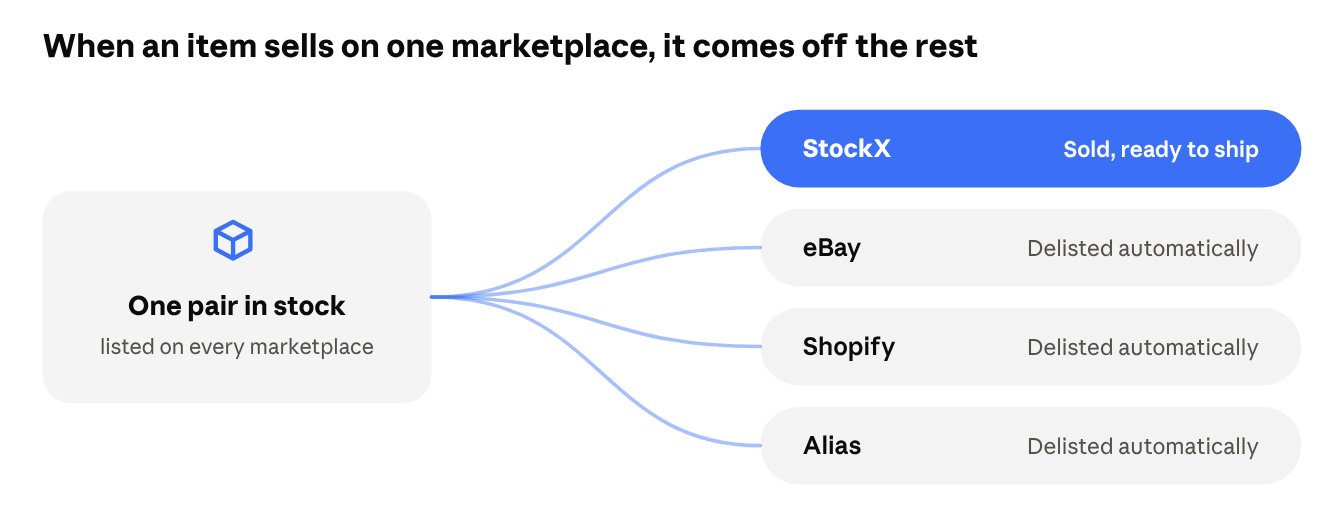
StockX, StockX Direct, Alias, eBay, and the ShipNinja B2B Marketplace list and delist from the same unit. A Shopify store gets the sellable count for that SKU, so the product page drops to zero when the last unit sells on another channel.
The pair that sold is already on the shelf
Delisting only handles the listings. The pair still has to leave inside that marketplace's shipping window.
At ShipNinja the inventory pool and the warehouse are the same thing. The pair was counted at check-in, so the order that imports is for a unit on our shelf. We pick, pack, and ship it inside that marketplace's window. A StockX Direct sale leaves on the label StockX sends with the order.
Your marketplace accounts and automations stay yours
You sync your own StockX, Alias, and eBay accounts, so payouts go straight to you. Auto-pricing and other listing automations keep running on those listings. Consigned stock can be imported into the same pool and delists the same way.
A sale from a marketplace that isn't connected ships as a custom shipment. You upload the label, and we pick that unit from the same shelf as the rest of your reseller inventory.
Tell us which marketplaces you sell on and your monthly order count, and we'll quote fulfillment from one shared inventory pool.